
How to Choose Your First Set of Premium Woodworking Chisels
If you've been working with a hardware-store chisel set and wondering whether “premium” is worth the jump, here's a direct answer. It's written for woodworkers who've felt a cheap chisel round over after an afternoon of mortising, and for anyone about to spend real money on a first set who wants to get the sizes and types right the first time.
This guide is for hobbyists upgrading from a starter set, intermediate woodworkers filling gaps in a toolkit, and professionals who chop chisels for a living and are tired of replacing them. It is not for anyone doing rough carpentry, demolition, or prying. A premium edge is wasted on a chisel used as a pry bar. Buy a cheap one for that job and keep it far from the bench chisels.
It covers which of the five chisel types you actually need, whether to buy a set or individual pieces, how to choose a bevel angle, and what handle material to pick. None of that is on the sizing chart at a hardware store.
What “premium” actually means in a chisel
“Premium” gets used loosely in tool marketing. In a chisel it means four specific things: the steel, the heat treatment, the manufacturing tolerances, and the handle.
The steel
Cheap chisels are typically chromium-vanadium alloy or plain carbon steel. Both are soft by woodworking standards, which means they take an edge fast and lose it fast. A single session of chopping dovetails can dull one enough to need a full re-sharpen, not just a strop.
Premium chisels move up to a genuine tool steel. Two are common in the category:
- A2 tool steel: air-hardening, high-vanadium, alloyed for wear resistance. It holds an edge longer than carbon steel and takes somewhat more effort to sharpen because of that same wear resistance.
- O1 tool steel: oil-hardening, a traditional tool-steel choice. It takes a slightly sharper edge off the stone and sharpens a bit faster, but the edge doesn't hold up as long under repeated use.
A handful of premium chisel makers use proprietary powder-metallurgy steels instead of A2 or O1. These trade off differently again, typically excellent edge retention paired with a harder sharpening job. If a chisel is advertised with a steel name you don't recognize, ask what class of steel it actually is before assuming it beats A2 or O1 outright. Edge retention isn't the only variable that matters.
IBC's chisels are made from AISI High Vanadium A2 tool steel.
Heat treatment
Steel type is only half the story. How it's heat treated determines what the steel actually does at the bench. IBC's process is full stress relief, triple tempering, and cryogenic treatment, hardened to a target of 60–62 Rc. Cryogenic treatment, bringing the steel down to sub-zero temperatures after hardening, converts retained austenite into martensite, the harder, more stable structure that actually holds an edge. Two chisels can carry the same steel spec on paper and still perform differently at the bench if one skips that step.
Hardness
60–62 Rc is the target range for premium chisels. Budget chisels typically sit at 56–58 Rc. That two-to-four-point gap on the Rockwell C scale is the difference between an edge that survives a full session of chopping and one that needs touching up by lunch.
Manufacturing tolerances
Flatness of the back, squareness of the sides, and consistency of the bevel angle all affect how a chisel performs and how easily it sharpens. A back that isn't flat has to be lapped flat before the chisel can take a true edge. A budget chisel often needs real flattening work right out of the box. A premium chisel arrives closer to ready.
Handle materials
Covered in detail below, but briefly: premium chisels use hardwood handles (maple, walnut, and similar), not the synthetic or softwood handles common on budget lines.
What the price difference buys
Premium chisels typically run three to five times the price of a budget set. You're paying for steel that holds an edge longer, heat treatment that makes the steel's full potential real, tolerances that mean less setup work before first use, and a handle built to outlast the tool.
The five chisel types every woodworker should understand
Before deciding what to buy, know what you're choosing between. Five distinct chisel types cover nearly all bench work.
Bench chisel
The everyday chisel: paring, light chopping, general mortising in a pinch. Standard bevel angle is 25° for most work; a lower-angle 17° option exists for softer woods (more on that below). Available from 1/4" up to 1" in width. If you own one chisel, it's a bench chisel.

Mortise chisel
Built specifically for repeated, heavy chopping when cutting mortises: heavier stock, squared shoulders, and a thicker blade than a bench chisel, designed to take repeated mallet blows without deflecting. A bench chisel can chop a mortise in a pinch, but a dedicated mortise chisel is faster, more accurate, and won't twist under strain the way a thinner bench chisel can.

Paring chisel
Long, thin, and light, built for slicing across the grain under hand pressure only, never struck with a mallet. The extra length gives leverage and control for fine paring work like dovetail cleanup and trimming joints flush.

Butt chisel
A short-format chisel, useful for hinge mortises, cabinet installation, and anywhere a full-length chisel is too long to control. Most woodworkers don't think they need one until the first hinge job, and then it becomes a permanent fixture in the toolbox.

Skew chisel
Left- and right-handed matched pairs, ground at an angle for undercuts and fine joinery cleanup, especially dovetails. The most specialized of the five. Buy these last, once you know exactly what work calls for them.

If you're buying one chisel: a 1/2" bench chisel. If you're buying three: 1/4", 1/2", and 3/4" bench chisels, which cover the large majority of bench work. If you're buying a full set: bench chisels first, mortise chisels second.
Should I buy a complete set or individual chisels?
Both are valid, and the right answer depends on how committed you already are to the category.
A complete set makes sense when you know you're staying with premium chisels and want to skip choosing sizes one purchase at a time. Buying six chisels together typically costs somewhat less per chisel than buying the same six individually. It also means every chisel in your roll shares the same steel, heat treatment, and handle, with no mismatched feel across your kit.
Individual chisels make sense when you're testing whether premium is worth it to you, when you have a specific size gap to fill, or when budget means spreading the purchase out. There's no penalty for buying one 1/2" bench chisel to try before committing to a set.
The starter-set approach that works for most woodworkers moving up from a budget set: buy three bench chisels first (1/4", 1/2", 3/4"), covering the bulk of ordinary bench work, then expand into mortise or paring chisels once you know what your projects actually demand. Don't buy a paring chisel set if you never do fine paring work, and don't buy mortise chisels if you're not cutting mortises. Buy what the work in front of you calls for.
Standard 25° vs. low-angle 17° bench chisels
The bevel angle ground on the back of a bench chisel changes how it cuts and how durable the edge is under stress.
A standard 25° bevel is the general-purpose choice. It holds up under mallet strikes and heavier chopping, and it's the right default for hardwoods.
A low-angle 17° bevel takes a finer bite and slices more cleanly through softer woods and end grain, at the cost of a more delicate edge that dulls faster if pushed into harder material or struck hard.
A 17° edge feels sharper the moment it comes off the stone, but that edge fails faster in hardwoods than a 25° edge does. If most of your work is in hardwoods, stay with 25°. If you work primarily in softer woods (pine, cedar, poplar) or do a lot of slicing and end-grain work, the 17° line is worth the switch. It's a dedicated low-angle product, not a re-grind of the 25° line, so the geometry and edge support are built for the lower angle from the start.

Maple vs. walnut handles: which should I choose?
Functionally, the difference is negligible. Both are hardwoods, both hold up to years of use, and both feel similar in hand once you've used either for a while.
The real difference is aesthetic. Maple runs lighter, a cream to pale blonde tone, and shows handling marks and patina sooner than walnut. Walnut runs darker, from rich brown to near-black, and tends to hide wear as it ages rather than showing it.
Neither is “better.” It's a preference call, which is why IBC offers both across the line. The blade underneath is identical either way.
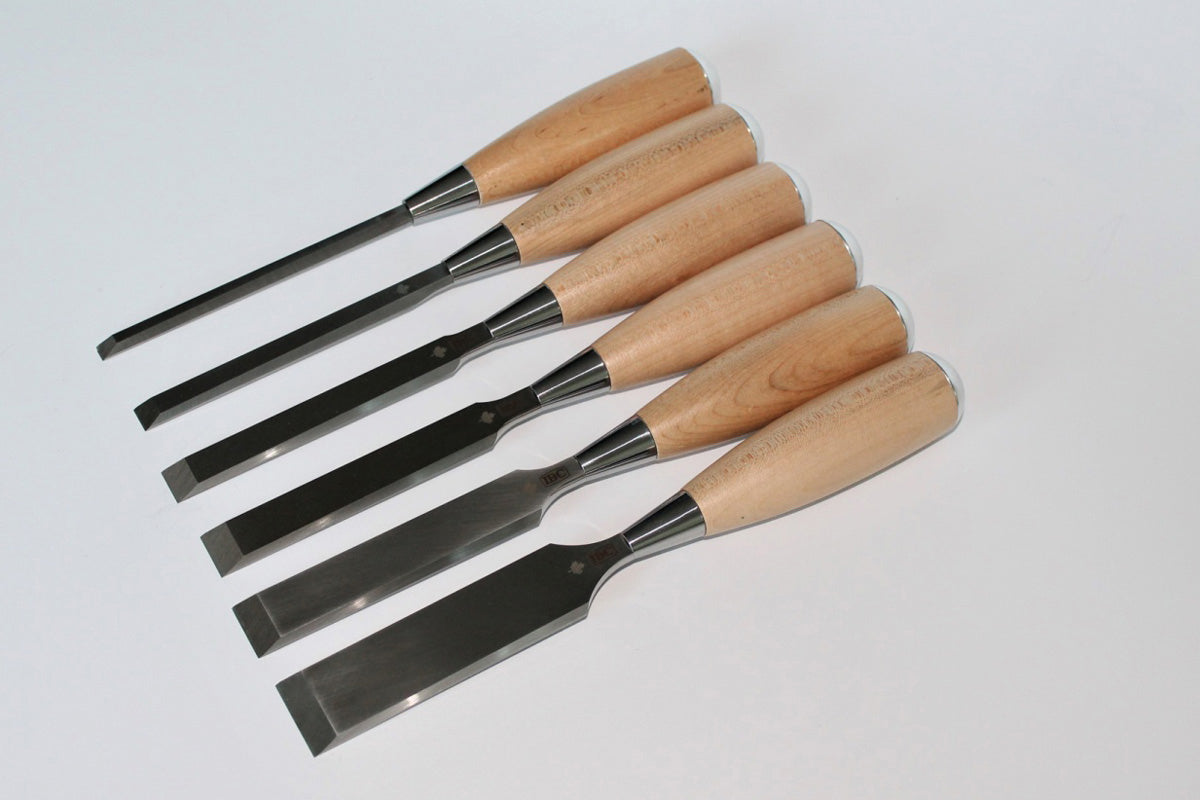
For paring chisels specifically, a long-format handle in either wood adds the extra leverage that fine paring work benefits from. Worth considering if paring is a regular part of your work.
Why IBC
IBC has been manufacturing precision woodworking blades in Toronto since 1997, and has produced more than 750,000 blades over that span. Every IBC chisel blade is AISI High Vanadium A2 tool steel, fully stress relieved, triple tempered, cryogenically treated, and hardened to 60–62 Rc, the same process on every blade regardless of size.
IBC's chisels also use a hybrid handle design: a threaded tang locks into a removable steel core inside the handle, with a center-bored ferrule that seats flat against both faces and a threaded striking cap securing the far end. The blade can be serviced or swapped independently of the handle, and the ferrule can be removed so the back of the blade lies perfectly flat for sharpening, something a fixed handle doesn't allow.

Fine Woodworking (May/June 2017) wrote that IBC “reimagines bench chisel design.” Hand planes equipped with blades contracted to IBC have won “Tool of the Year” awards.
Taking care of your premium chisels
Sharpening
Honing little and often beats letting an edge go dull and doing a full resharpen. A few strokes on a fine stone before or during a project keeps the edge working; save the full sharpening sequence for when the edge is visibly rounded or chipped. IBC chisels arrive with a flat, ready back, so the first sharpening is typically a light hone rather than a flattening job.
Handle care
Hardwood handles benefit from an occasional light oiling to keep the wood from drying out, particularly in low-humidity conditions. If a handle ever cracks, IBC sells replacement handles separately, no need to replace the whole chisel.
Storage
A chisel roll, a magnetic strip, or a dedicated drawer all work. The main thing to avoid is loose storage where edges knock against other tools.
When to replace
A well-made chisel outlasts most projects it's used on. Replacement is rare for the blade itself; handles wear or crack well before the steel gives out.
Frequently asked questions
What's the difference between A2 and O1 steel for chisels?
A2 is air-hardening and alloyed for wear resistance, so it holds an edge longer between sharpenings but takes a bit more effort on the stone. O1 is oil-hardening, sharpens a little faster, and takes a very sharp edge, but that edge doesn't last as long under use. Most woodworkers doing regular bench work find A2's longer edge life worth the slightly longer sharpening sessions.
How often should I sharpen my chisels?
Less often than you'd think if you hone regularly. A quick pass on a fine stone every session or two keeps an edge working. A full sharpening, back to the coarse stone, is only needed when the edge is visibly dull, chipped, or rounded.
Do I need different chisels for hardwoods vs. softwoods?
Not different chisels, but a different bevel angle helps. A standard 25° edge handles both, but a low-angle 17° edge cuts more cleanly in softer woods and end grain, at the cost of a more delicate edge in hardwoods.
How sharp should my chisels be out of the box?
IBC chisels arrive with a flat back and a usable edge, ready for a light hone before first use rather than a full sharpening sequence.
Can I use bench chisels for mortising?
Occasionally, yes, but a dedicated mortise chisel is built for it: heavier stock and squared shoulders that resist twisting under repeated mallet strikes. A bench chisel used regularly for mortising will wear faster and can flex more than you'd want.
What's the right size set for a beginner?
Three bench chisels, 1/4", 1/2", and 3/4", cover most bench work a beginner encounters. Expand from there based on the specific work you take on.
Should I buy individual chisels or a set?
A set is typically a modest savings over buying the same sizes individually and guarantees consistency across your kit. Individual chisels make sense if you're testing the brand or filling one specific size gap.
Why do premium chisels cost so much more than budget chisels?
Tool steel instead of soft carbon steel, a heat-treatment process (stress relief, triple tempering, cryogenic treatment) that fully develops the steel's properties, tighter manufacturing tolerances, and a hardwood handle built to last. Each adds real cost and real performance.
Can I sharpen these myself, or do I need professional sharpening?
Almost every woodworker sharpens their own chisels. It's a basic, learnable skill and part of normal chisel ownership. A set of sharpening stones and a few minutes of practice is all it takes to keep a premium chisel performing as intended.
How do I know if my chisel handle needs replacement?
Visible cracks, looseness where the handle meets the ferrule, or damage from being struck off-center are the signs. The blade itself will typically outlast several handles over a chisel's working life.
Your buying framework in one sentence
Type first (bench chisels cover most work), size second (start with 1/4", 1/2", 3/4"), handle third (maple or walnut, your call), bevel angle fourth (25° for hardwoods, 17° for soft woods and end grain).
Made in Toronto since 1997.